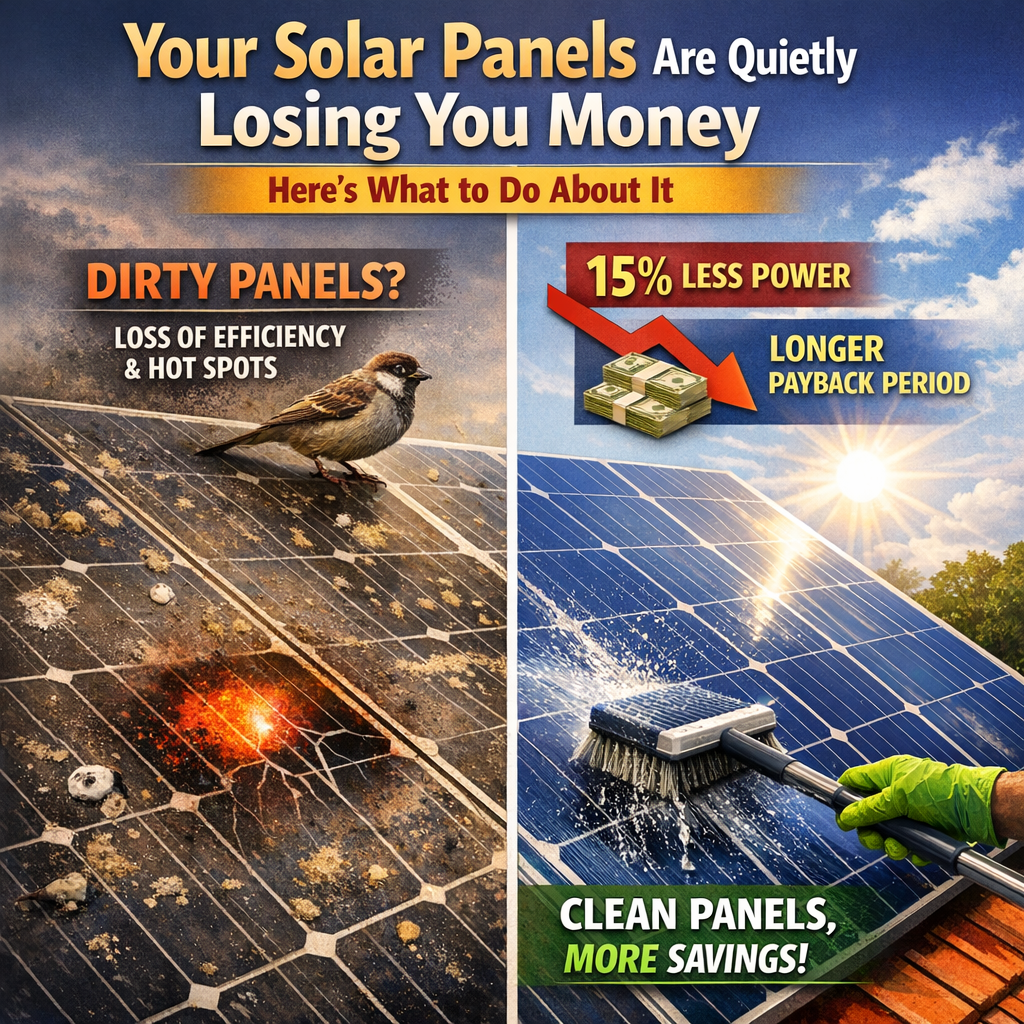
Your Solar Panels Are Quietly Losing You Money — Here's What to Do About It
Most people who go solar do their research, get the install done, and then never think about it again. Which makes sense, the whole appeal is passive energy. But there's one thing that quietly chips away at your returns every single day, and it has nothing to do with inverters or wiring.
Your panels are dirty. And it's costing you more than you think.
The "Set and Forget" Myth
Solar panels are genuinely impressive, no moving parts, built to handle the elements, designed to last 25 years or more. That durability breeds complacency. And the irony is that the very environment that makes solar viable, open sky, full sun exposure is also what covers your panels in grime. Dust, pollen, bird droppings, road dust. None of it is dramatic. That's the problem. You can't see a 12% efficiency loss from the ground.
What Soiling Actually Does to Your Output
The industry calls this buildup "soiling." When dust or grime sits on the glass, it reflects and absorbs incoming light before it ever reaches the silicon cells. Studies consistently put the efficiency loss at 10–15% for moderate buildup, but do the math and it gets real quickly. A system producing 10,000 kWh per year at peak efficiency loses 1,200 kWh annually at just 12% soiling. In coastal areas, high-pollen regions, or anywhere with heavy bird activity, losses can push beyond 20%.
The Hidden Threat: Hot Spots
Dust reducing your output is annoying. Hot spots can destroy your panels.
When one cell gets shaded by a bird dropping or clump of debris while the rest of the panel is in full sun, it stops generating electricity and starts dissipating it as heat instead. Temperatures at that spot can climb dramatically, causing cell degradation, discolouration, and in serious cases, cracked glass or delamination. Hot spots are one of the leading causes of premature panel failure and almost entirely preventable with regular cleaning.
Your Payback Period Is Longer Than It Needs To Be
When your system was installed, the projected payback period assumed clean panels and optimal output. Soiling wasn't factored in. Every kilowatt-hour your dirty panels fail to produce is one you're buying from the grid instead, quietly extending your payback period in a way that's invisible until you actually check your numbers.
Twice-yearly cleaning is enough for most residential systems. If you're in a dusty area, near the coast, or under regular bird flight paths, go quarterly it will pay for itself in recovered output.
What Your Warranty Might Require
Many manufacturers include maintenance clauses in their warranties. Bird droppings are mildly acidic and left to bake on glass in direct sun, they can permanently etch the surface. Regular cleaning isn't just about output, it preserves the structural integrity of your panels over their full lifespan. If you ever need to make a warranty claim, a record of regular maintenance can matter more than you'd expect.
How to Clean Them Without Causing Damage
Timing matters. Never spray cold water on panels baking in afternoon sun, thermal shock can crack tempered glass. Clean at sunrise or after the panels have cooled in the evening.
Skip the soap. Most household detergents leave a film that attracts dust faster than a clean surface would. Plain water handles the job. For stubborn spots, a little isopropyl alcohol on a cloth works without residue.
Use soft tools. A microfiber cloth or purpose-made solar brush is ideal. Abrasive materials cause micro-scratches that compound over time. Avoid pressure washers too high-pressure water can compromise frame seals and damage wiring connections.
Know when to call someone. A steep roof plus a wet surface is a genuine safety risk. Professional cleaners use deionised water that evaporates completely clean, and many offer thermal imaging inspections that can catch hot spots before they become permanent damage.
The Bottom Line
Twice a year, plain water, a soft brush. That's genuinely all it takes to make sure your system is capturing every drop of available sunlight instead of bouncing it off a layer of dust. It's the easiest high-return maintenance task most solar owners never bother with and the simplest reason systems underperform against their projected numbers.
Don't let dirt be the reason your investment takes longer to pay off than it should.