What Those Three Numbers on Your Car Battery Label Actually Mean
Most South Africans buying a replacement battery walk into the shop, hand over the old one, and trust that whatever comes back is good enough. But there are three numbers on every battery label that are worth understanding, because they determine whether your car starts on a cold Highveld morning, whether your music keeps playing while you're braaiing with the engine off, and whether you make it to the next offramp if something goes wrong on the highway.
Here's what each one means in plain language.
Take a look at our automotive range.
CCA: Cold Cranking Amps
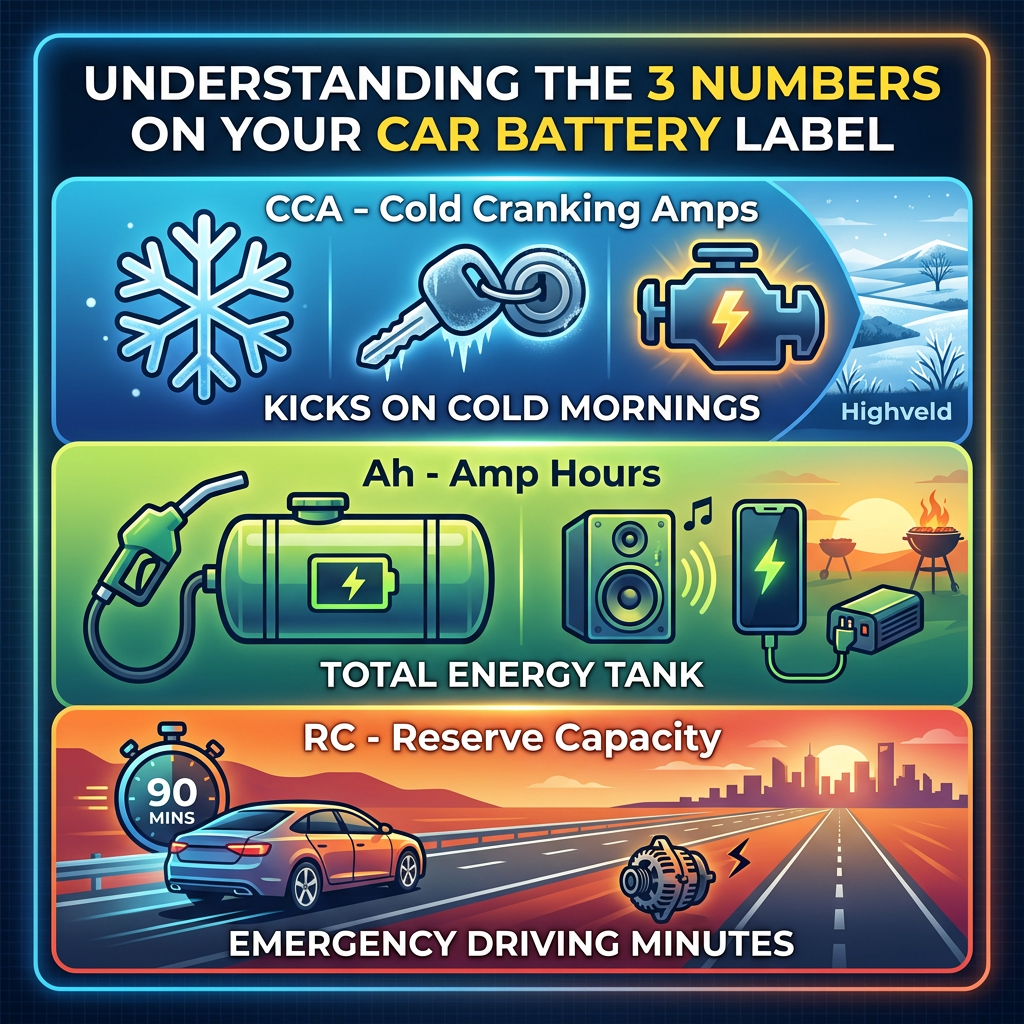
CCA measures how hard your battery can kick to get the engine turning over when it's cold.
When temperatures drop, engine oil thickens. A thicker oil is harder to push through the engine, which means the starter motor needs more electrical power to do its job. If your battery doesn't have enough CCA for those conditions, you turn the key and get that dreaded slow chug, or nothing at all.
Now, if you live in Cape Town and it never really gets cold where you park, CCA is less of a daily concern. But if you're in Johannesburg, Pretoria, the Highveld, the Drakensberg, or anywhere that sees proper winter mornings, CCA becomes one of the most important numbers on the label. A frosty July morning in Joburg is not the time to discover your battery was slightly underpowered.
The rule is simple: never go lower than what your car manufacturer specifies, and if you're in a cold region, going a bit higher won't hurt at all.
Ah: Amp Hours
Ah measures how much total energy the battery can store, think of it exactly like the size of a fuel tank, but for electricity instead of petrol.
A 60Ah battery can deliver 3 amps of power continuously for 20 hours before it's flat. A 100Ah battery can do the same for longer, or power something more demanding for the same amount of time. The higher the Ah rating, the bigger the "tank."
This number matters most when your engine is off but you're still drawing power. In South Africa, that situation comes up more than most people realise. Running a sound system at a braai with the car parked. Charging phones and laptops. Powering a small inverter during load shedding while you're sitting in the driveway. All of that drains the battery without the alternator running to top it back up.
If you regularly use your car as a power source, even just for phone charging and music, a higher Ah rating gives you significantly more headroom before the battery goes flat and you need a jump start.
Need a battery for your motorbike? No problem, we got you covered.
RC: Reserve Capacity
RC tells you how many minutes your battery can keep the car running on its own if your alternator fails while you're driving.
Your alternator is the component that generates electricity while the engine is running. It powers everything in your car and keeps the battery charged at the same time. If it dies mid-drive, the battery has to take over alone, and it's not designed to do that for long.
The RC number tells you exactly how long you've got. A battery with an RC of 90 means you have roughly 90 minutes of driving time before the voltage drops too low and the car starts cutting out, lights, fuel pump, ignition, everything.
Picture this: your alternator packs up somewhere on the N1 between Joburg and Pretoria. A low RC battery might give you 40 minutes. A higher RC battery gives you closer to two hours. That's the difference between making it to a garage and being stranded on the side of the highway calling for a tow.
RC doesn't get talked about as much as CCA or Ah, but in a country where you can find yourself far from help very quickly, it's the number that could genuinely save you from a very bad day.
We also stock a wide range of Heavy Duty batteries. Click to see.
The Short Version
CCA is your cold-start insurance, especially important in winter, on the Highveld, or anywhere temperatures drop overnight. Ah is your energy reserve, the bigger the tank, the longer you can run accessories without the engine running. RC is your safety net, the more minutes you have, the better your chances of getting off the road safely if something goes wrong.
When you next replace your battery, don't just match the size. Check all three numbers, and make sure none of them are lower than what your car's manufacturer recommends.