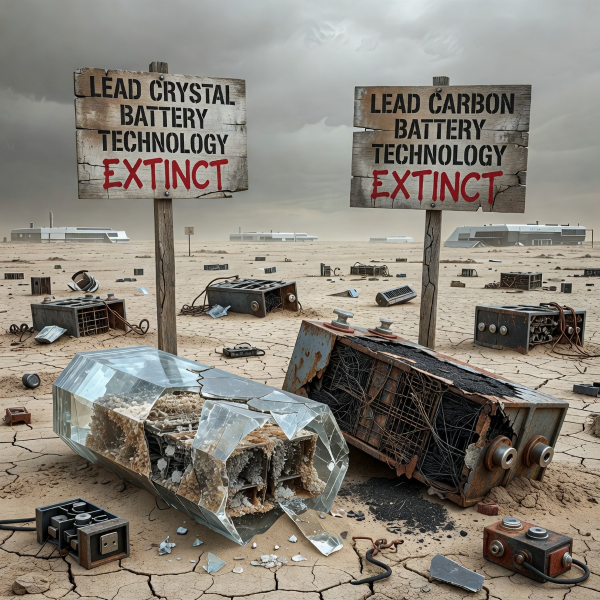
What happened to Lead-Carbon and Lead-Crystal Batteries
Over the past few years the South African battery market has changed dramatically.
Today, lithium-ion batteries — particularly Lithium Iron Phosphate (LiFePO4) — dominate solar and backup power installations.
By 2024 lithium accounts for more than 90 percent of the market.
During the transition away from traditional lead-acid batteries, two technologies briefly appeared as potential alternatives: lead-carbon and lead-crystal batteries. Both were marketed as improvements on conventional lead-acid systems.
However, neither gained meaningful traction in South Africa and today they are rarely imported or installed.
Understanding why requires a closer look at how these technologies work and why lithium ultimately replaced them.
Traditional Lead-Acid Batteries
Lead-acid batteries have been used for more than 160 years and remain common in vehicles and certain backup applications.
Their advantages include low upfront cost, simple charging requirements and a well-established recycling ecosystem. However, they also have significant limitations. Only around 30–50 percent of their capacity can be safely used without damaging the battery, they charge slowly, require maintenance, and typically last between 200 and 800 cycles.
These limitations became particularly problematic when South Africa began experiencing frequent load shedding. Repeated cycling, partial charging and rapid recharge requirements expose the weaknesses of lead-acid technology.
Lead-Carbon Batteries
Lead-carbon batteries were developed to improve traditional lead-acid performance by adding carbon material to the negative electrode. This modification improves electrical conductivity and reduces sulfation, which is one of the primary causes of lead-acid battery failure.
The technology promised several improvements over conventional lead-acid batteries. These included longer cycle life, faster charging and improved performance when operating at partial state of charge.
Despite these benefits, lead-carbon batteries still retain many of the fundamental limitations of lead-acid chemistry. Usable capacity remains restricted, the batteries are heavy, and specialised charging profiles are often required to achieve their advertised lifespan.
The biggest challenge was cost. Lead-carbon batteries often cost two to three times more than standard lead-acid batteries while still delivering far lower performance than lithium. As a result they fell into an awkward middle ground: too expensive to compete with basic lead-acid systems, yet significantly inferior to lithium solutions.
Lead-Crystal Batteries
Lead-crystal batteries are a variation of valve-regulated lead-acid technology that use a silica-based gel electrolyte rather than liquid sulphuric acid. The design incorporates thicker plate structures and is often marketed as a major breakthrough in battery technology.
Manufacturers frequently claim extremely long lifespans, high charging speeds and resistance to sulfation. In practice, however, these claims have not been consistently supported by real-world installations.
Lead-crystal batteries also have demanding charging requirements. Many systems require higher charging currents than typical residential solar systems can provide, which can result in under-charging and reduced lifespan.
Another major challenge is limited global availability. Few major battery manufacturers produce lead-crystal batteries, and replacement units can be difficult to source. Combined with pricing similar to entry-level lithium systems, the value proposition becomes difficult to justify.
The Impact of Load Shedding
South Africa’s ongoing load shedding accelerated the shift toward lithium battery technology.
Backup systems often need to cycle multiple times per day while also recharging quickly between power outages. This operating pattern places heavy stress on lead-based batteries, which struggle with partial state-of-charge cycling and slow charging speeds.
Lithium batteries, particularly LiFePO4, were designed for exactly this type of use. They can recharge quickly, tolerate frequent cycling and maintain consistent performance across thousands of charge cycles.
Where traditional lead-acid batteries may last one to two years in heavy load shedding conditions, lithium systems can often operate for many years with minimal degradation.
Why Lithium Became the Dominant Technology
Several factors contributed to lithium’s rapid adoption in South Africa.
First, lithium batteries offer far greater usable capacity. Around 90 percent of their stored energy can be safely used, compared with roughly half for lead-based systems.
Second, lithium batteries have significantly longer lifespans. Many LiFePO4 batteries deliver between 2 000 and 10 000 cycles, far exceeding the capabilities of lead-acid technologies and offer much longer warranty periods.
Charging speed is another major advantage. Lithium batteries can recharge far faster than lead-based systems, allowing them to recover between load shedding events.
They also require no maintenance, weigh less, and provide consistent performance across a wide range of operating conditions.
As global production expanded — largely driven by the electric vehicle industry — lithium battery prices also declined significantly. This reduced the price gap and made lithium a far more compelling long-term investment.
The Resulting Market Shift
The combined impact of these advantages led to an extremely rapid market transition.
Lithium batteries represented only a small portion of the solar storage market before 2019. As load shedding intensified and lithium prices fell, adoption increased quickly. By the mid-2020s lithium had become the default choice for most residential and commercial energy storage systems in South Africa.
Today the market is heavily dominated by lithium technology, while lead-carbon and lead-crystal batteries account for only a tiny fraction of installations.
What This Means for Consumers
For most solar and backup power applications in South Africa today, lithium batteries provide the best balance of performance, reliability and long-term value.
Lead-acid batteries still serve important roles in automotive starting applications and certain specialised uses, but for energy storage systems they are increasingly being replaced by lithium solutions.
Lead-carbon and lead-crystal technologies were attempts to extend the life of traditional lead-acid chemistry. While they offered some improvements, they could not compete with the performance gains delivered by lithium.
The decline of lead-carbon and lead-crystal batteries illustrates an important principle in technology markets: incremental improvements to older technologies often struggle to compete with a fundamentally better alternative.
Lithium-ion batteries delivered higher efficiency, faster charging, longer lifespan and better suitability for South Africa’s load shedding conditions. As a result they rapidly became the dominant energy storage technology.
Today lithium is not only the most common battery choice in South Africa — it has effectively set the standard for modern backup power and solar energy storage systems.